

 English



Why Steel Structure Building Need Wall Bracing?
Wall bracing is a critical, non-negotiable element in steel structure design. It's not about holding up the weight of the building (that's the job of the columns and beams), but about providing lateral stability and resistance to horizontal forces.
Think of a steel frame without bracing as a house of cards. It's fine if you only push straight down (gravity), but the slightest sideways push will cause it to collapse. Bracing turns that flexible frame into a rigid, stable box that can withstand these lateral forces.
Here’s a detailed breakdown of why wall bracing is absolutely necessary:
1. To Resist Lateral Loads
The primary purpose of bracing is to counteract horizontal forces that act on the building. These forces come from:
Wind Load: The most common lateral load. Wind pressure pushes against the sides and roof of the building. Bracing transfers this pushing force down to the foundation, preventing the frame from racking (leaning) or collapsing.
Seismic Load (Earthquakes): In earthquake zones, the ground shakes horizontally. Bracing systems are crucial for dissipating this massive energy, allowing the structure to sway in a controlled manner without catastrophic failure.
Crane Thrust & Other Operational Loads: In industrial buildings, the starting, stopping, and movement of overhead cranes create significant horizontal forces that the bracing system must absorb.
2. To Provide Overall Stability and Rigidity
Without bracing, a rectangular steel frame is inherently unstable. Its beams and columns are connected with simple shear connections (like web cleats) that are designed to transfer vertical load, not to resist rotation. This creates a mechanism that can easily collapse.
Bracing turns the frame into a series of stable triangles (the strongest geometric shape). It creates lateral load-resisting systems (like braced frames or shear walls) that give the structure its shape and prevent it from deforming under load.
3. To Transfer Loads to the Foundation
Bracing creates a clear, efficient load path. Horizontal forces are collected by the roof and wall cladding, transferred into the bracing elements (roof bracing and wall bracing), then channeled down through the columns, and finally into the ground via the foundation. Without this path, the forces have nowhere to go, causing local failures.
4. To Prevent Buckling of Primary Members
Under heavy compressive loads, long, slender columns are susceptible to buckling (bending sideways). Bracing provides lateral support to these members at intermediate points, effectively shortening their unbraced length and dramatically increasing their load-carrying capacity. This is often called discrete or member bracing.
Common Types of Wall Bracing Systems:
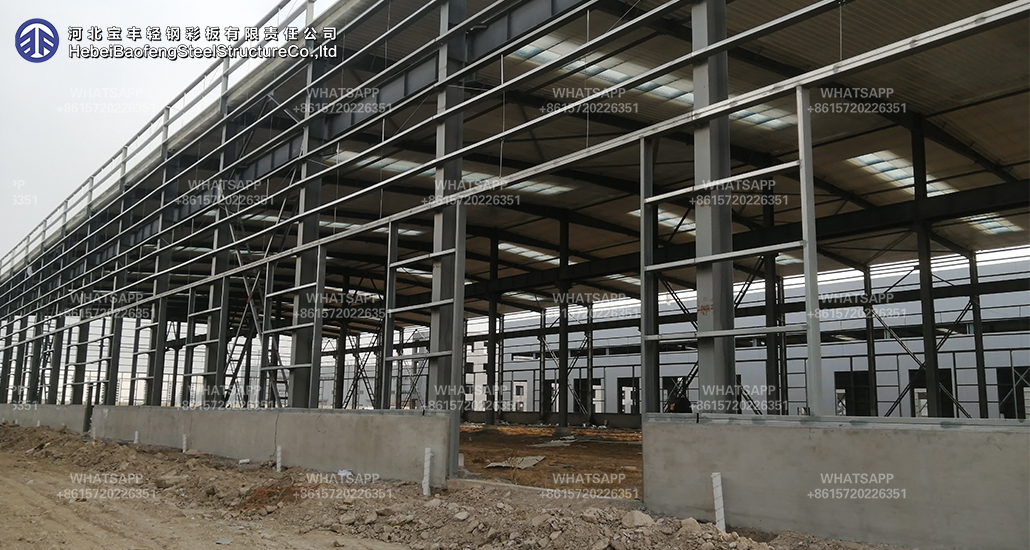
Diagonal (or X) Bracing: The most recognizable type. Steel rods, cables, or sections are placed in an "X" pattern within a wall bay. They work in tension—one diagonal resists the pull in one direction, the other resists the opposite pull. Very efficient and economical.
K-Bracing or V-Bracing: The bracing members meet at a single point on the horizontal beam. While efficient, the concentrated force at the beam can be a design challenge.
Shear Walls: Instead of steel braces, a solid wall (often made of concrete, masonry, or steel plates) is used. The entire wall acts as a deep beam to resist lateral forces. Common in multi-story buildings.
Moment-Resisting Frames: This is an alternative to bracing where the beam-to-column connections are designed to be rigid, forming a strong frame that resists rotation and lateral forces through bending. Often used where bracing would interfere with architectural openings.
Consequences of Inadequate or Missing Wall Bracing:
Structural Collapse under wind or earthquake events.
Excessive Sway, making occupants feel uneasy (serviceability issue) and potentially causing damage to non-structural elements like cladding and partitions.
Progressive Failure, where the failure of one element overloads adjacent members, leading to a chain reaction.
In summary, wall bracing is the skeleton's ligaments and tendons. While the columns and beams (the bones) carry the weight, the bracing system provides the essential stiffness and strength to keep the entire structure stable against all the sideways pushes and pulls it will face over its lifetime. It is a fundamental requirement for safety, serviceability, and longevity in steel construction.
Categories
latest blog
Tags


For inquiries about our products or pricelist, please leave to us and we will be in touch within 24 hours.
© Copyright: 2026 Hebei Baofeng Steel Structure CO.,LTD All Rights Reserved.

IPv6 network supported


 +8615720226351