

 English



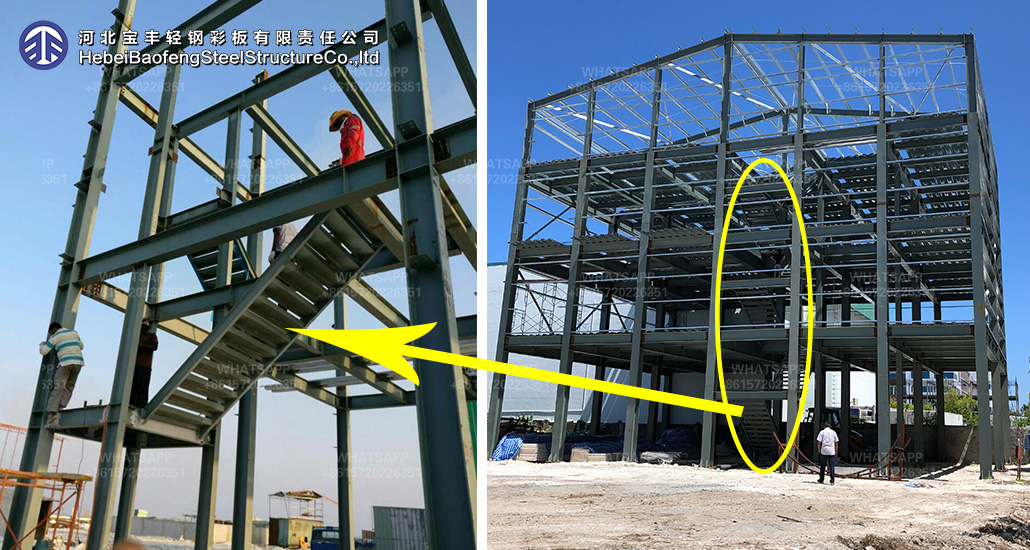
Stair Of Steel Structure Buildings
The design and construction of the stair in steel structure buildings is a critical element that bridges the architectural intent with structural and code requirements. Here is a comprehensive overview, from design principles to construction details.
Key Design Advantages of Steel Stairs
Strength and Durability: Steel has a high strength-to-weight ratio, allowing for slender, elegant designs that are extremely robust and long-lasting.
Design Flexibility: Steel can be easily fabricated into straight runs, spirals, curved stringers, and complex geometric forms, supporting both modern minimalist and industrial aesthetic visions.
Prefabrication: Components can be precision-cut, welded, and finished off-site in controlled factory conditions, leading to faster, higher-quality, and less weather-dependent installation.
Fire Resistance: While steel loses strength at high temperatures, it is non-combustible. Fire protection (encasement, intumescent paint, sprinklers) is a key design consideration, not an afterthought.
Integration: Steel stairs easily integrate with other building systems (e.g., seismic bracing, mechanical services) and can be designed as part of the building's lateral load-resisting system.
Primary Components
Stringers: The main inclined members supporting the treads. Common types:
Channel or I-beam Stringers: Treads are welded or bolted to the top.
Plate (Sawtooth) Stringers: Made from plate steel cut in a sawtooth profile; treads sit on the "teeth."
Monostringer (Central Spine): A single, often box-section, stringer running down the center, with treads cantilevered from it for a "floating" look.
Treads and Risers: Treads are the stepping surface; risers are the vertical elements between treads. Treads are often serrated or perforated metal plate, grating, or can support other finishes (stone, wood, terrazzo).
Handrails and Guardrails: Typically made from steel pipe, tube, or cable infill. Must comply with stringent building codes for height (usually 42" for handrail, 42"-60" for guardrail), graspability, and infill spacing to prevent falls.
Supports and Connections:
Landing Frames: Rectangular frames that support intermediate landings, often welded from beams/channels.
Moment Connections: Fixed connections that resist rotation, used at supports for stability.
Simple Shear Connections: Pinned or bolted connections that allow for some rotation, simplifying erection and accounting for deflection.
Critical Design Considerations & Codes
Building Codes: Compliance with IBC (International Building Code), OSHA (for workplace safety), or local equivalents is non-negotiable. Key code dictates include:
Riser/Tread Dimensions: Maximum riser height (typically 7.75") and minimum tread depth (typically 10"). Must be uniform.
Width: Minimum clear width for egress (e.g., 44" for occupant load >50).
Loads: Live Loads (typically 100 psf for residential, 150+ psf for public/assembly), Concentrated Loads (e.g., 300 lbs on a 4"x4" area), and Deflection Limits (e.g., L/360 under live load).
Vibration and Deflection: Steel is inherently "springy." The design must ensure adequate stiffness to prevent excessive vibration or bounce, which is uncomfortable for users. This often dictates member sizing more than pure strength.
Fire Protection: The required fire-resistance rating (1hr, 2hr) dictates the protection method: spray-applied fire-resistive material (SFRM), gypsum board encasement, or intumescent paint (which expands when heated, forming an insulating char).
Connection Design: Connections must be designed for all anticipated loads, including horizontal forces on handrails. They must also accommodate erection tolerances and potential differential movement in the building frame.
Egress and Occupancy Load: The stair's capacity, number, and enclosure are determined by the building's occupancy classification and occupant load.
Common Types of Steel Stairs
Industrial Stairs: Utilitarian, often with grating treads, open risers, and simple pipe railings. Common in factories, plant rooms, and fire escapes.
Architectural Feature Stairs: Designed as focal points. May use monostringers, glass balustrades, and custom-fabricated details.
Egress / Fire Stairs: Enclosed in fire-rated shafts. Focus is on durability, code compliance, and fire protection. Often have concrete-filled pans for fire resistance and sound dampening.
Spiral Stairs: Space-saving, with all treads radiating from a central column. Governed by specific code dimensions for tread geometry.
Challenges and Solutions
Fireproofing Detailing: Achieving a clean, durable finish with fireproofing at complex connections is challenging. Intumescent paint offers a cleaner aesthetic but at a higher cost.
Vibration: Solved by increasing member size, using closed (box) sections, or adding strategic bracing.
Noise: Metal-on-metal contact and "drumming" can be mitigated with rubber pads at connections, concrete fill on treads, or non-metallic tread covers.
Tolerances: Coordination is vital between the structural frame (which may deflect) and the stair, which requires precise geometry. Slotted holes or adjustable connections are often used.
In summary, the stair in a steel structure is a complex subsystem that requires close collaboration between the architect, structural engineer, and steel fabricator. Its success lies in balancing aesthetic vision, structural integrity, user safety, and strict adherence to building codes.
Categories
latest blog
Tags


For inquiries about our products or pricelist, please leave to us and we will be in touch within 24 hours.
© Copyright: 2026 Hebei Baofeng Steel Structure CO.,LTD All Rights Reserved.

IPv6 network supported


 +8615720226351